Knitting and fabric08 · Knitting and weavingPinnedAnswered

Single jersey, interlock, rib: what is the difference and where does each go?

Answered by BHR · Knitting technologistKnitting mill8 posts · 6 sources

  1. QuestionKnitting and fabric#1

    The question

    Where yarn becomes knitted fabric and terry cloth.

    Step 08 of 12Knitting and weaving
  2. BHR · Knitting technologistKnitting mill#2

    What happens

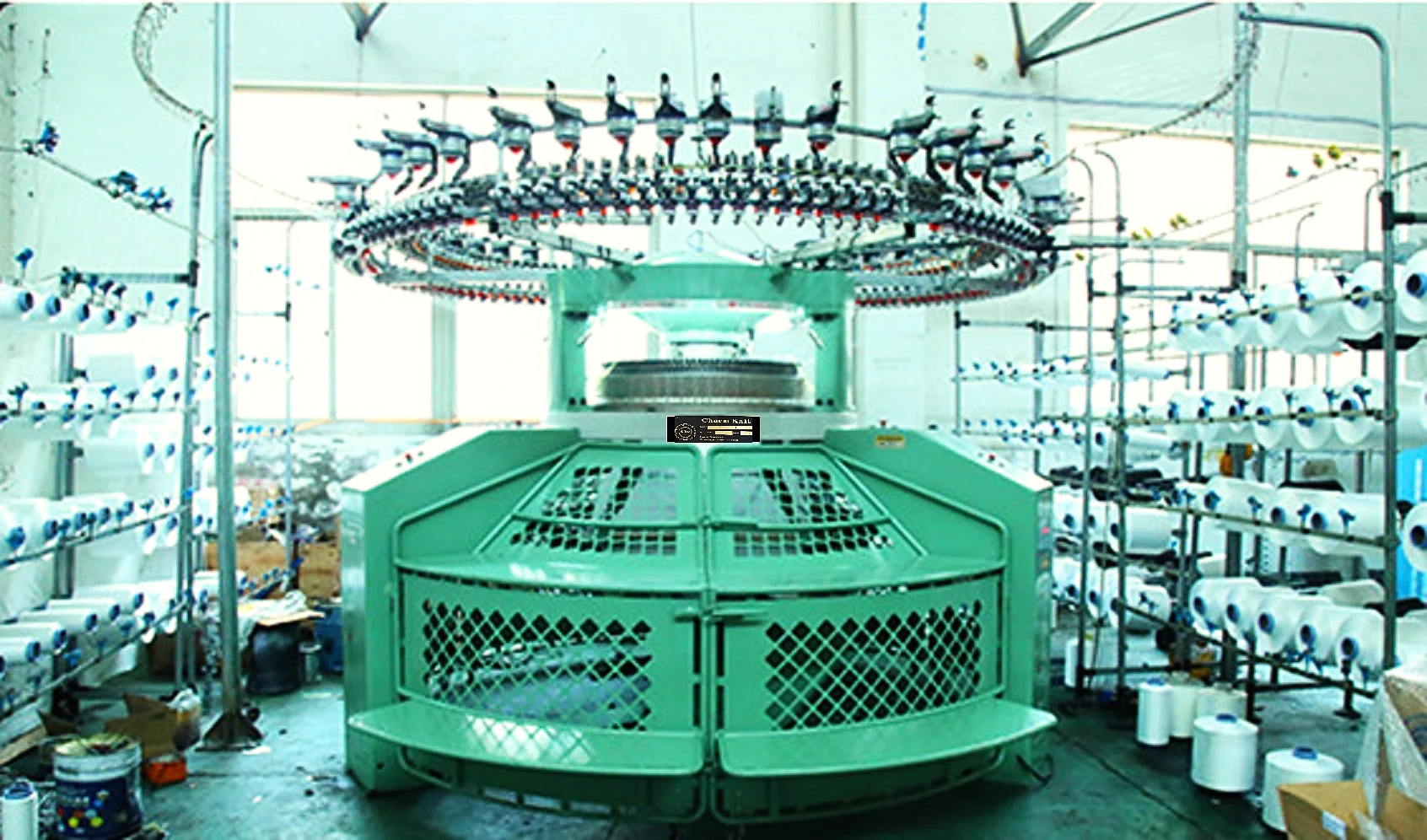
    Yarn becomes cloth in one of two ways. For T-shirts, polos and sweatshirts, circular knitting machines draw yarn from dozens of cones and form interlocking loops, producing a continuous tube of fabric. Needle spacing (gauge) and the length of yarn in each loop largely decide the fabric's weight, width and shrinkage. Different set-ups give single jersey, rib, interlock or fleece. For towels and bathrobes, terry looms use two sets of lengthwise yarns (warps): a tightly tensioned ground warp forms the base, and a loosely tensioned pile warp is pushed up into loops. Rolls are then weighed and inspected for defects.

  3. BHR · Knitting technologistKnitting mill#3

    Why it matters

    1. Cotton Incorporated calls the knitting set-up the single most important factor in shrinkage. With the same yarn, a shorter loop gives heavier, more stable fabric.
    2. Skewed fabric makes T-shirt side seams twist after washing. In Cotton Incorporated trials, single-jersey skew after five home launderings rose from 8.6% to 16.8% as stitches were loosened.
    3. Barré: unwanted bands across knitted fabric, often visible after dyeing. Causes include mixing yarn counts, suppliers or twist, and wrong stitch length or tension at one feed.
    4. Pile height strongly affects towel weight and also absorbency. In one industrial trial, raising it from 5.4 to 9.0 mm took weight from about 417 to 575 g/m².
  4. BHR · Knitting technologistKnitting mill#4

    Best practice

    • Engineer the knit to the finished specification: choose yarn count, machine gauge, needle count and stitch length together to reach the agreed weight, width and shrinkage, rather than correcting later in finishing.cottoninc.com (opens in a new tab)
    • Prevent barré: label and separate yarn lots; never mix counts, suppliers or twist on one machine; keep stitch length and tension equal at every feed; dye a trial sample before bulk runs.cottoninc.com (opens in a new tab)
    • Control spirality at the source: match yarn twist direction to cylinder rotation, alternate S- and Z-twist feeds or use plied yarn, and measure skew after washing (AATCC TM179 or ISO 16322-2).cottoninc.com (opens in a new tab)
    • On terry looms, keep pile-warp tension constant and set pile height electronically so loops stay even along the roll. Test towel absorbency with a recognised method such as ASTM D4772.picanol.be (opens in a new tab)
    • Grade rolls by visual inspection to ASTM D5430, usually its 4-point system: each defect scores 1–4 points by length, per 100 square yards, against a limit agreed with the buyer.store.astm.org (opens in a new tab)
    • Test weight (ASTM D3776) and wash shrinkage (ISO 6330 with ISO 5077) on samples first conditioned at 20 ± 2 °C and 65 ± 4% relative humidity (ISO 139).store.astm.org (opens in a new tab)
  5. BHR · Knitting technologistKnitting mill#5

    At BHR

    • 1 200tonnes of knitted fabric a year (about 4 t a day) at the Navoiy knitting mill
    • 7knit structures: single jersey, rib, interlock, piqué, fleece, velour, kashkorse
    • Mayer & Cieknitting machines, alongside Terrot, Jumberca and Monarch
    • 2 400tonnes a year from the 20 000 m² terry weaving mill in Jondor, Bukhara region
  6. BHR · Knitting technologistKnitting mill#6

    Did you know?

    On the same 28-gauge single-jersey machine, Cotton Incorporated found fabric knitted only from Z-twist yarn skewed 15.3% after five home launderings; alternating S- and Z-twist feeds cut this to 1.4%.

    cottoninc.com (opens in a new tab)
  7. BHR · Knitting technologistKnitting mill#7

    The terms

    Stitch length
    The length of yarn in one knitted loop; shorter loops make denser fabric.
    GSM
    Fabric mass in grams per square metre; higher usually means thicker, denser cloth.
    Gauge
    Needles per inch of a knitting machine's cylinder; also called 'cut'.
    Pile warp
    Loosely tensioned lengthwise yarn in terry cloth that forms the towel's loops.
    Spirality (skew)
    Slanting of knitted fabric after washing that twists garment side seams.
  8. BHR · Knitting technologistKnitting mill#8

    Sources

    1. Cotton Incorporated TRI 3011: Wet Processing of 100% Cotton Knitted Fabrics (opens in a new tab)cottoninc.com
    2. Cotton Incorporated TRI 2002: Knit Fabrics and the Reduction of Torque (opens in a new tab)cottoninc.com
    3. Cotton Incorporated TRI 1002: Barré (opens in a new tab)cottoninc.com
    4. Sekerden, Wood and Fiber Science: pile height and terry towel properties (opens in a new tab)wfs.swst.org
    5. Picanol: Pile formation system for terry weaving (opens in a new tab)picanol.be
    6. ASTM D5430: Standard Test Methods for Visually Inspecting and Grading Fabrics (opens in a new tab)store.astm.org

From cotton picking to finished garment in 12 steps

  1. 01Growing cotton
  2. 02Cotton picking
  3. 03Ginning
  4. 04Fibre testing and classing
  5. 05Opening, blending and cleaning
  6. 06Carding and drawing
  7. 07Spinning and winding
  8. 08Knitting and weaving
  9. 09Dyeing and finishing
  10. 10Pattern making and cutting
  11. 11Sewing and printing
  12. 12Inspection, packing and delivery

Still have a question on this?

Did not find the answer here? Send us your question.

Send a question