ProductionSewing
Sewing
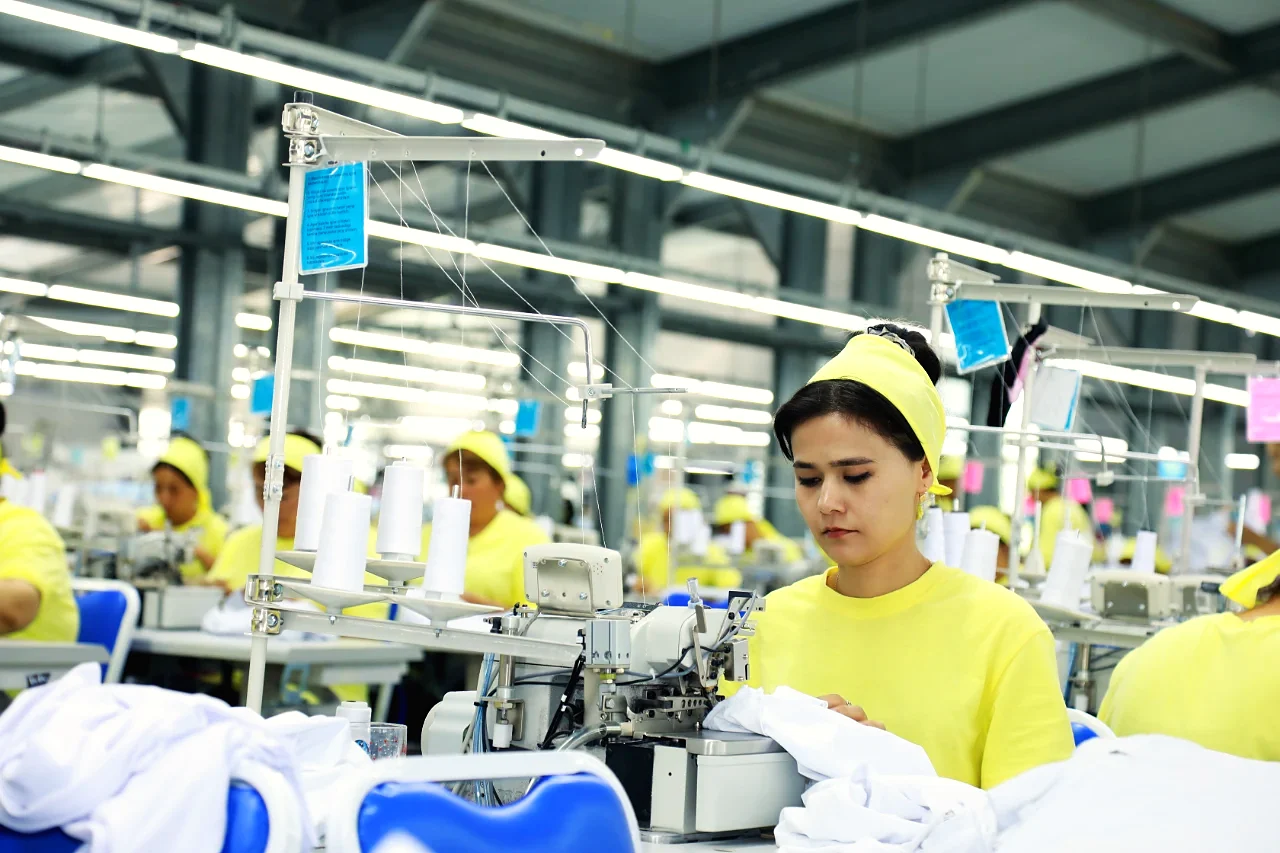
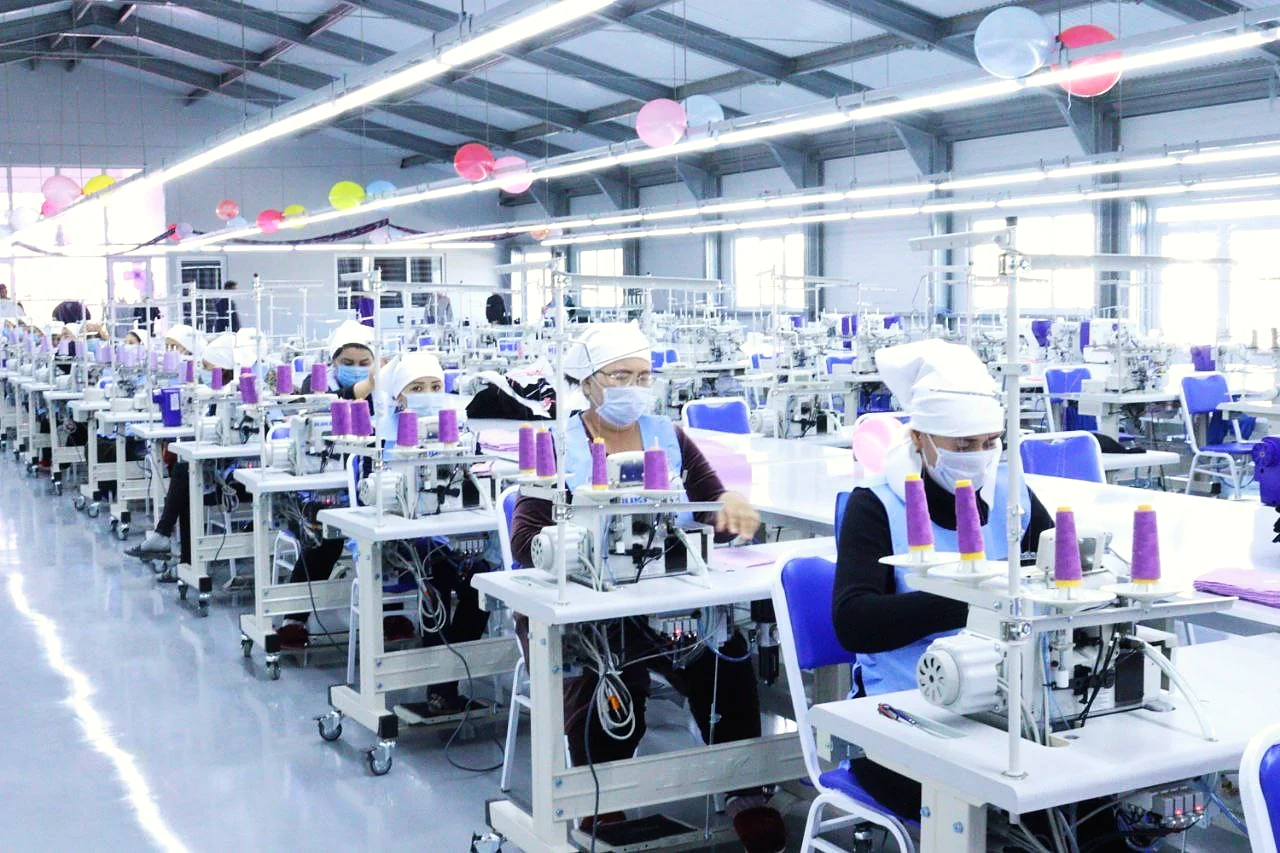
Two sewing factories and a screen-printing shop in Tashkent printing up to 20 colours — from T-shirts to childrenswear.
5.5 million pieces a year
Step 10 of 12
Pattern making and cutting
Where fit, shade and fabric use are decided.
Before cutting, the garment exists as a tech pack: sketches, measurements, materials and tolerances. Pattern makers turn it into flat pattern pieces, usually digital, and grade them into every size. Software packs the pieces as closely as possible on a cutting plan called a marker. Knitted fabric is first left to relax, easing built-up tension. Rolls are laid layer upon layer on a long table without stretching; this is spreading. An automatic cutting machine or a skilled cutter cuts the whole stack at once. Pieces are numbered, sorted by size and shade, and bundled for sewing.
At BHR
- 2 000 m²
- Tashkent head office, home to planning, pattern-making and design departments
- Bullmer Procut
- Automatic cutter, Qorajon factory
- OZBILIM
- Fabric spreading equipment, Qorajon factory
- DTM
- Fabric spreading equipment, BHR Beta Tex factory
Step 11 of 12
Sewing and printing
From cut panels to finished, printed garments.
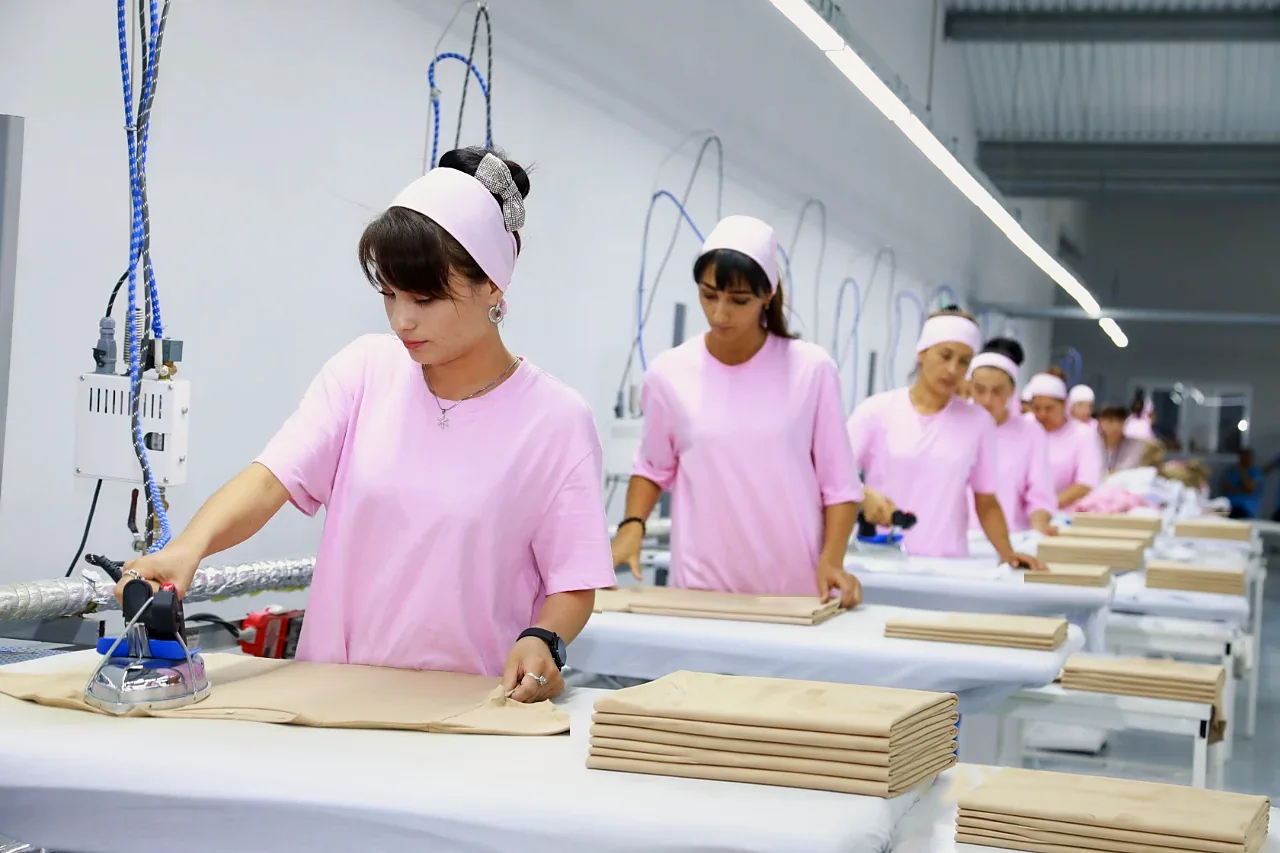
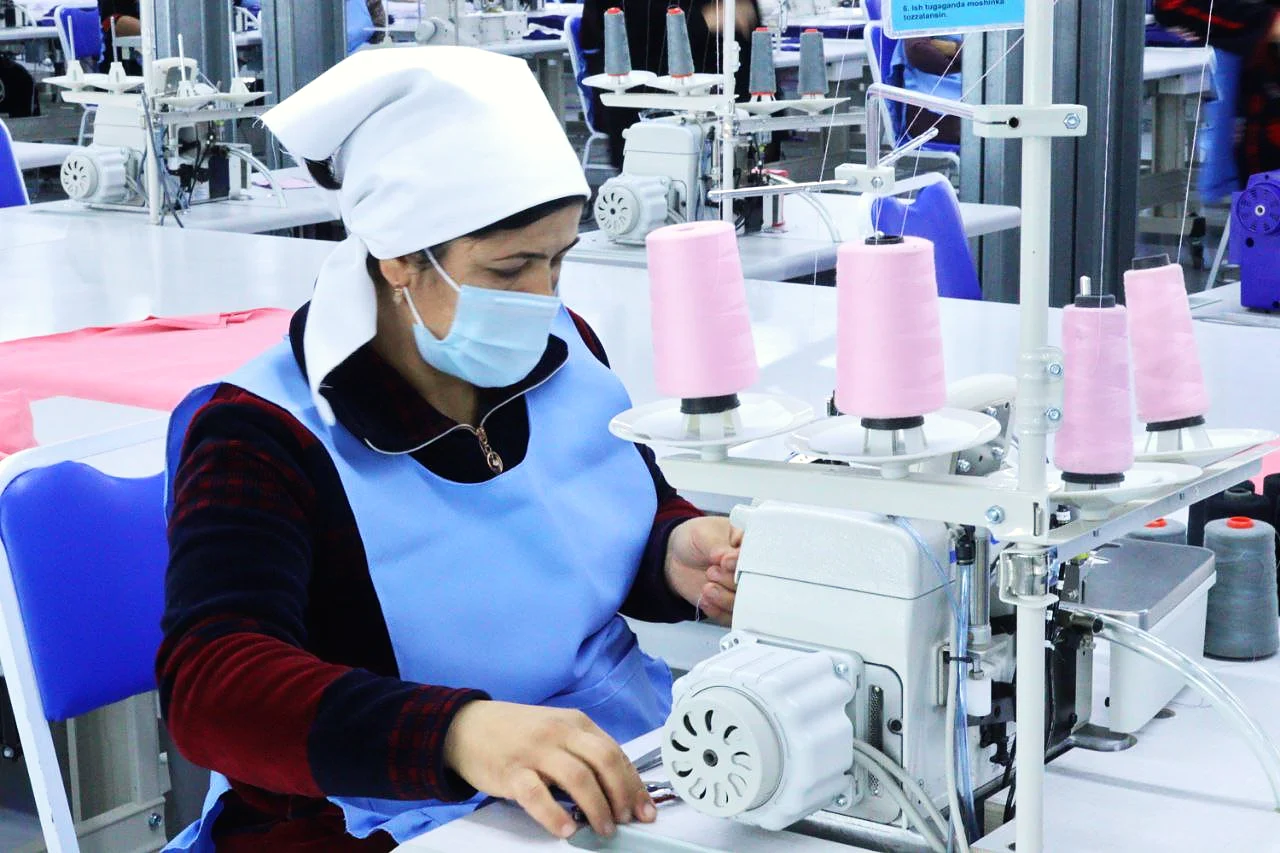
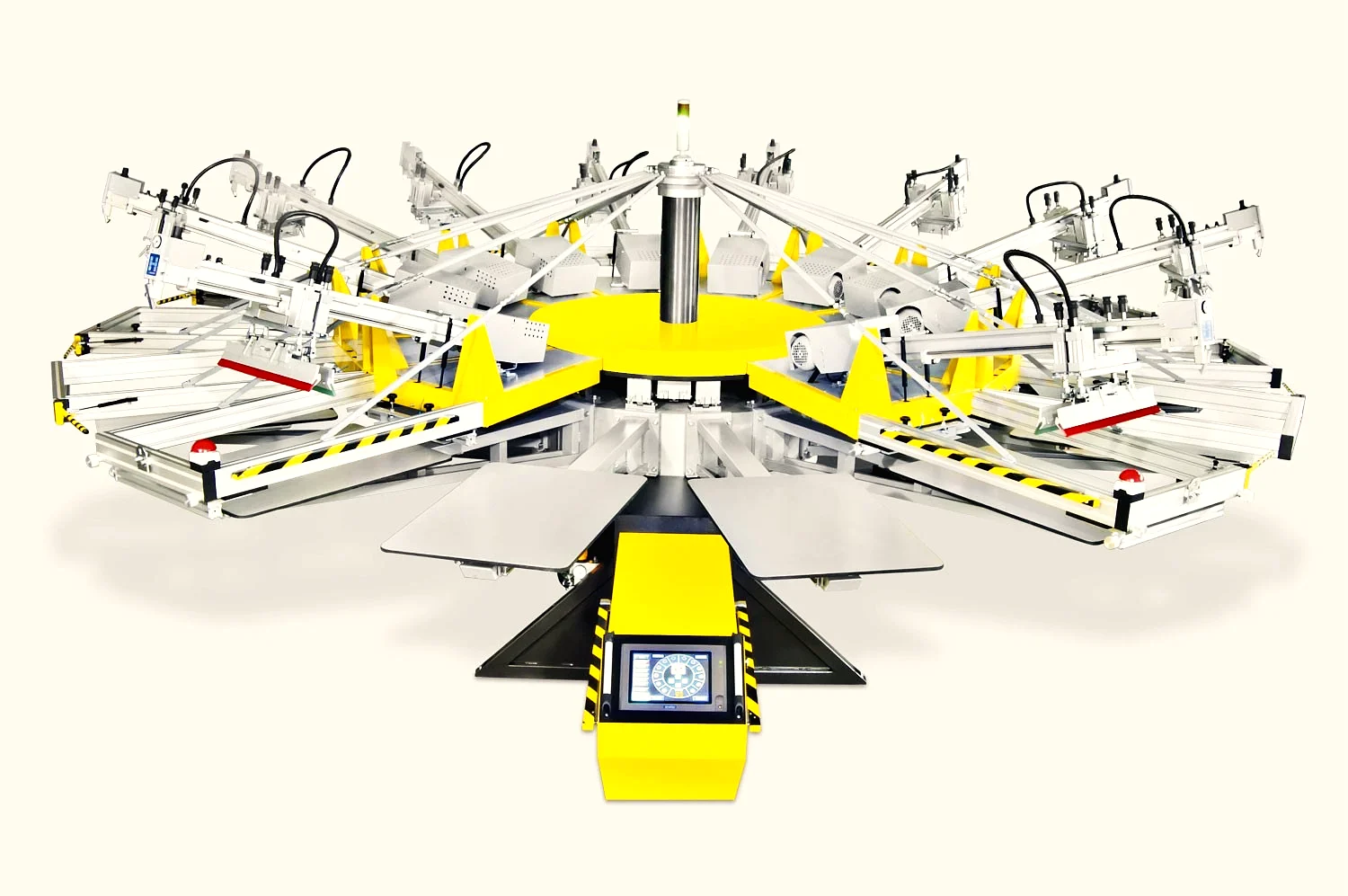
Knitted panels, cut to pattern, are joined into garments on specialised machines. Overlock machines sew and neaten the cut edge in one pass. Cover-stitch machines make the flat, stretchy hems on sleeves and bottoms; lockstitch machines sew details. The work is split into short operations along a sewing line, each timed so that no station holds up the next. Screen printing pushes ink through a fine mesh stencil, one screen per colour, and the print is then heat-cured so that it survives washing. Finally, steam and heat press each garment into shape before inspection and packing.
At BHR
- 5 500 000
- garments a year at our two sewing factories in Navoiy region
- 20
- colours per print, maximum, at our Tashkent screen-printing shop
- 100 × 70
- cm maximum print area, SULFET equipment
- Kansai · Union Special
- sewing machines at both factories
Step 12 of 12
Inspection, packing and delivery
Final checks before garments leave the factory.
Garments are usually checked at two stages. Inline inspection on the sewing lines catches faults during production. Final inspection takes a random sample from each finished lot, sized by statistical tables (ISO 2859-1), and checks sewing and fabric faults, colour shade, labels and measurements against the buyer's specification. If faults exceed the agreed limit, the lot is rejected and usually sorted, reworked and re-inspected. Many buyers require a needle detector for childrenswear; separate social audits check working conditions. Garments are then folded, bagged, packed into marked cartons and shipped with a packing list, invoice and origin documents.
At BHR
- SMETA
- Sedex social audits by TÜV SÜD, August 2022, at Navbahor Tekstil LLC and Qorajon Textile LLC
- QC
- Quality control departments at every stage, from cotton seed to finished product
Where it is made
Our own plants.
Qorajon sewing factory
Navbahor district, Navoiy region
- Floor area
- 2 600 m²
- Capacity
- 2,000,000 pieces a year
- Equipment
- Bullmer Procut, Juki, Kansai, Union Special, Malkan
BHR Beta Tex sewing factory
Qiziltepa district, Navoiy region
- Floor area
- 3 900 m²
- Capacity
- 3,500,000 pieces a year
- Equipment
- DTM, Siruba, Kansai, Union Special, Malkan
Head office and print shop
Yakkasaroy district, Tashkent
- Floor area
- 2 000 m²
- Capacity
- 100 × 70 cm, up to 20 colours
- Equipment
- SULFET
Good practice
How it is done well.
Measure how much each fabric lot shrinks in washing and build that allowance into patterns and markers before cutting. Cotton Incorporated notes that brands expect shrinkage to be low and consistent.
Source cottoninc.comGrade patterns from a documented table of body measurements. ISO 8559-1 defines how body measurements are taken; ISO 8559-3 sets out how to build such tables and the steps between sizes.
Source iso.orgPlan markers so pieces fit together as closely as possible, and record pattern yield: the share of fabric that becomes cut pieces. A high-yield layout is called a ‘tight marker’.
Source cottonworks.comLet knitted fabric relax before spreading, then lay each layer flat, tension-free, with one edge aligned. Automatic spreaders are built for this, to give more accurate pieces and fewer sewing rejects.
Source lectra.comGroup rolls by shade, number every layer, and keep each garment's panels from one layer through bundling and sewing. Numbering avoids matching colour by eye, which can fail under poor lighting.
Source patents.google.comSpecify stitch type and density: overlock for knit seams, cover stitch for flat hems, and, per thread maker A&E, about 10–12 stitches per inch for jersey, 14–18 with elastane.
Source coats.comUse ball-point needles suited to the knit, sized ‘as thin as possible and as thick as necessary’ (Groz-Beckert). If a stretched test seam shows holes, go a size smaller. Replace worn needles.
Source groz-beckert.comSwap needles strictly one for one. After a break, match every fragment to a whole needle; if a piece is missing, isolate the garments. Keep records at least a year.
Source primark.a.bigcontent.ioCure to the ink data sheet, measuring the ink film, not the dryer setting: about 160 °C for most standard plastisols, about 121–148 °C for low-cure grades. Then stretch- and wash-test.
Source lawsonsp.comBalance the line: time each operation (its SMV) so no station becomes a bottleneck. In one knitwear factory study, line balance rose from 45% to 85% and productivity from 45% to 58%.
Source article.sapub.orgUse ISO 2859-1 sampling tables. At the usual inspection level (II), a lot of 3 200 pieces is judged on 125; at a buyer-agreed AQL of 2.5, 8 defective pieces reject it.
Source itl.nist.govControl every needle. Primark's 2011 supplier policy: one needle out, one in; broken pieces taped to a record sheet; all childrenswear through a metal detector calibrated at least four times daily.
Source primark.a.bigcontent.ioMake every product traceable. Since 13 December 2024, EU Regulation 2023/988 requires an identifier such as a batch number, plus the manufacturer's name, postal and electronic address, on the product or packaging.
Source gov.ukUse a shareable social audit such as Sedex SMETA, done by Sedex-approved auditors against ILO conventions and local law. It is not a certificate; its value lies in fixing recorded issues.
Source sedex.comPack and ship dry. Marine insurers advise 45–70% relative humidity and 10–30 °C for garments, moisture absorbers in airtight packs, clean leak-proof containers, and no stowage with food or odorous cargo.
Source tis-gdv.de
Terms 14
- Tech pack
- A garment's technical file: sketches, measurements, materials, tolerances and construction details.
- Grading
- Scaling a base pattern up and down to produce every size in the range.
- Marker
- A layout plan showing how all pattern pieces fit onto the fabric before cutting.
- Spreading
- Laying fabric layer upon layer on the cutting table, without stretching.
- Pattern yield
- The share of fabric, in per cent, that ends up as cut pieces.
- Overlock (overedge) stitch
- A stitch that joins fabric and wraps its cut edge in one pass.
- Stitches per inch (SPI)
- Number of stitches in one inch of seam; it affects strength, stretch and appearance.
- Curing
- Heating a print until the whole ink layer fuses and becomes wash-resistant.
- Plastisol ink
- Screen-printing ink that forms a tough, elastic film when heated.
- Standard minute value (SMV)
- The time one operation should take, in minutes, set by work study.
- AQL (Acceptance Quality Limit)
- The worst average defect rate a sampling plan still accepts most of the time.
- Critical defect
- A fault that could make the garment unsafe, such as a broken needle.
- Needle detector
- Conveyor that stops and sounds an alarm on sensing iron-based metal in garments.
- SMETA
- Sedex Members Ethical Trade Audit: an independent check of working conditions.
A question, or an order?
The sales contact for this line answers.
Send a request