Knitted vs woven fabric: what’s the difference?
A T-shirt and a shirt can both be 100% cotton and still behave completely differently. It comes down to how the yarn is put together.
Key takeaways
- Woven: two sets of crossing yarns; holds its shape.
- Knitted: loops; stretchy and soft.
- Towel terry is woven, with a looped pile that soaks up water.
Two garments can be made from the same cotton and still feel nothing alike. A T-shirt stretches and recovers; a shirt keeps its shape. The difference lies in how yarn becomes fabric: by knitting or by weaving.
Woven fabric
Weaving uses two sets of yarn. Warp yarns run along the fabric; weft yarns cross them at right angles, passing over and under. The result is stable and firm, with little stretch unless elastane is added, and cut edges fray — a cut knit edge, by contrast, curls and runs. Denim, poplin shirts, bed sheets and towels are woven.
Knitted fabric
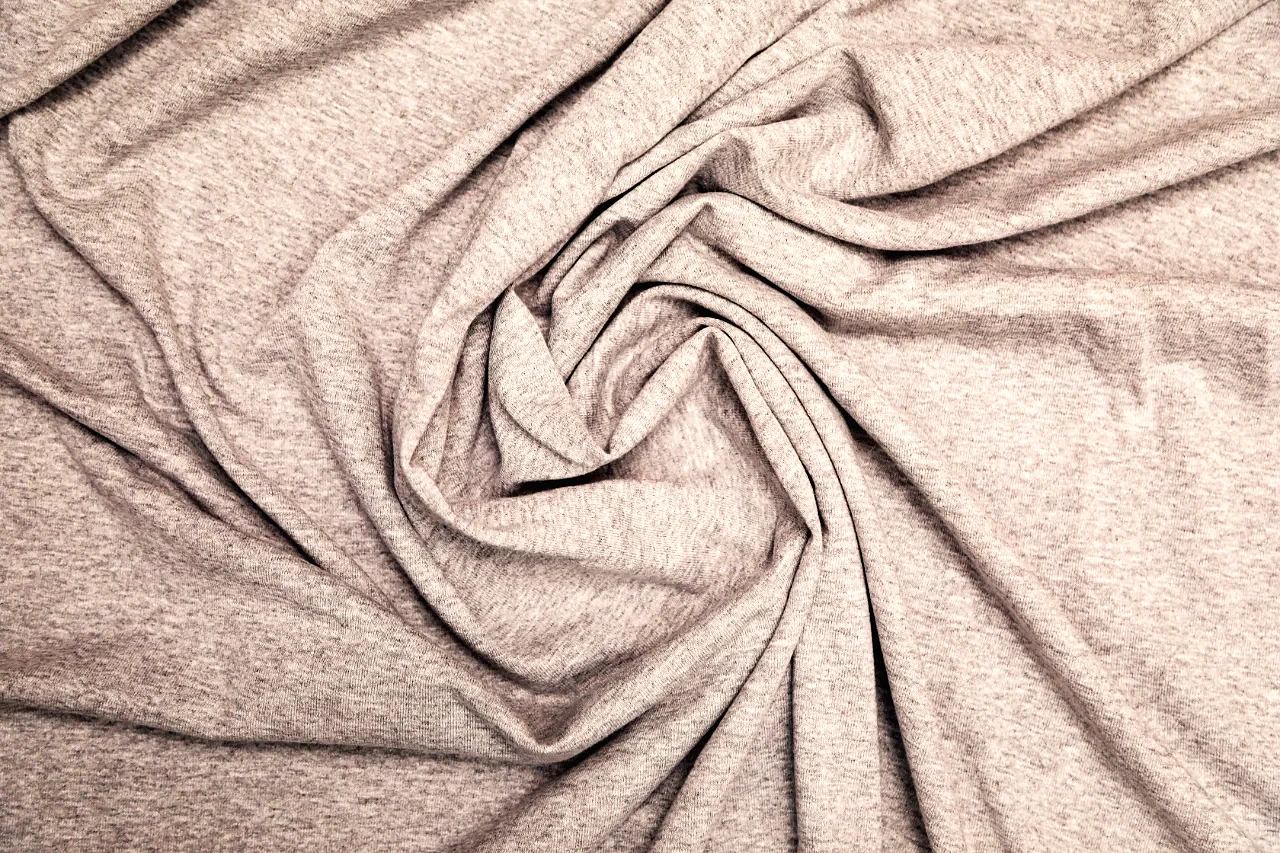
Knitting builds fabric from loops. On a circular knitting machine, thousands of needles pull the yarn through the previous row of loops. Because loops can open and close, knitted fabric stretches, recovers and resists creasing. It feels soft and follows the body, which is why T-shirts, polos, underwear and sportswear are knitted.
Common knitted fabrics
- Single jersey — smooth face, loops on the back; the classic T-shirt fabric.
- Interlock — two layers knitted together; thicker and identical on both sides.
- Rib — raised vertical lines and strong stretch; for cuffs, collars and fitted tops.
- Piqué — textured surface; the polo-shirt fabric.
- Fleece (2- or 3-thread) — smooth face with extra yarn looped on the back, often brushed for warmth; used for sweatshirts.
Where terry fits
Terry is a woven fabric with an extra set of warp yarns that form loops on both faces of the cloth. The pile acts as a mass of fine capillaries that draw water in and hold it, which is why terry is so absorbent.
How to tell them apart
Stretch the fabric gently: a knit gives noticeably in width, a woven barely moves. Look closely: a knit’s face shows rows of small “V”s (arcs on the back); a woven shows a grid, or a diagonal line in denim and other twills.
Sources
- The Woolmark Company — Weaving Wool (opens in a new tab)woolmark.com
- Cotton Incorporated (CottonWorks) — Basic Woven Fabric Designs (opens in a new tab)cottonworks.com
- Cotton Incorporated (CottonWorks) — Knit Basics (opens in a new tab)cottonworks.com
- Cotton Incorporated (CottonWorks) — Single & Double Knits (opens in a new tab)cottonworks.com
- Groz-Beckert — Knitting: Products and services for the large diameter circular knitting sector (opens in a new tab)groz-beckert.com
- Australian Wool Education Trust / University of New England (WoolWise, WOOL482/582) — Topic 20: Formation and Properties of Knitted Structures (opens in a new tab)woolwise.com
- Petrulytė & Baltakytė, Kaunas University of Technology — Investigation into the Wetting Phenomenon of Terry Fabrics (Fibres & Textiles in Eastern Europe) (opens in a new tab)epubl.ktu.edu
More news and articles
All news and articles The new bhr.uz is liveThe new bhr.uz is open in Uzbek, Russian and English, with the BHR Spinning colour card, our production stages and a knowledge base.
 Cotton vs cashmere: what’s the difference?One grows on a plant, the other on a goat. How the two fibres differ, and why one is not a cheaper version of the other.BHR · Fibre laboratory
 What does Ne 30/1 mean? Yarn count explainedThe number on a yarn spec tells you how fine the yarn is. How to read it and convert it to other systems.BHR · Spinning technologist
Still have a question on this?
Did not find the answer here? Send us your question.