Quality and testing
What is tested at each stage from fibre to garment, what the results mean, and how a buyer checks a lot and a certificate.
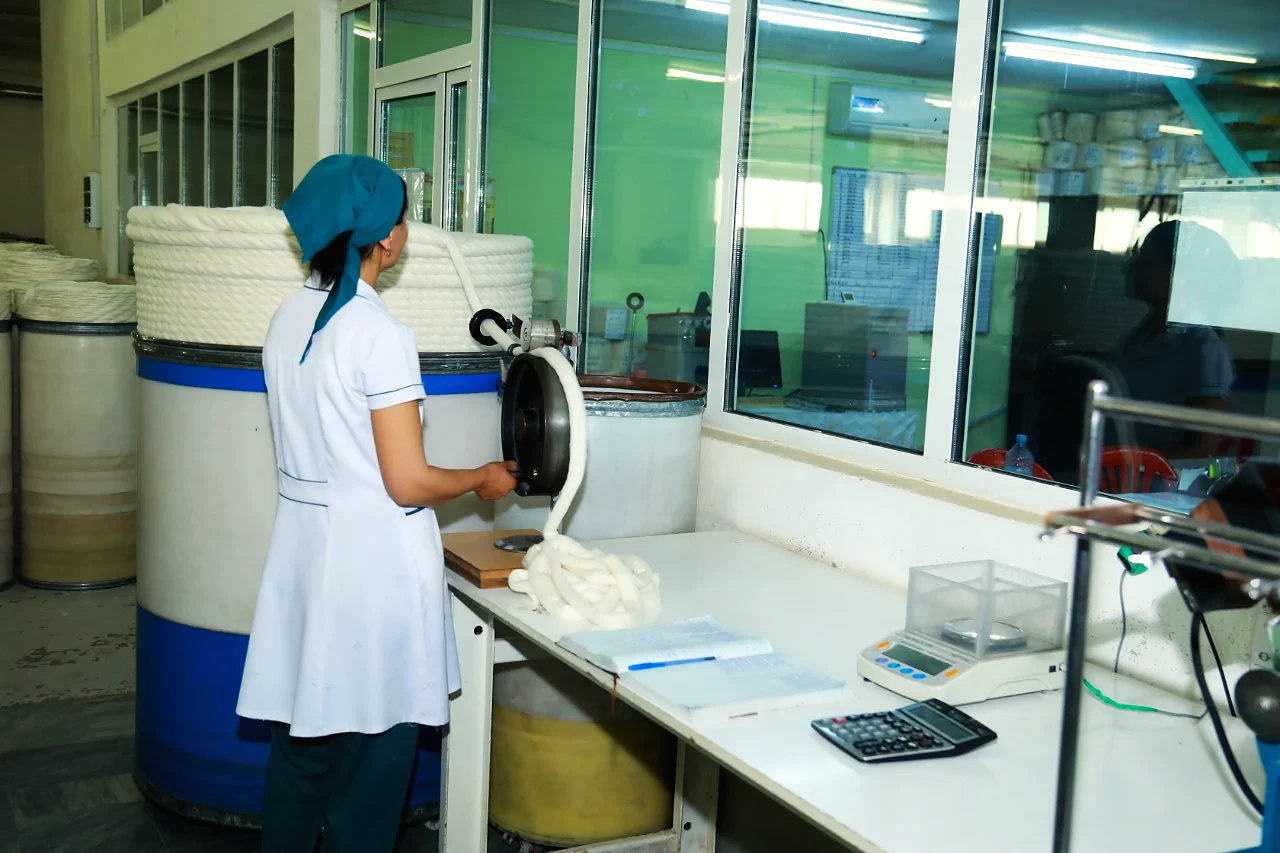
Fibre and yarn
HVI measures each cotton bale for length, uniformity, strength, micronaire, colour and trash. AFIS tests single fibres for what HVI misses: neps, short fibres, maturity and fineness, which predict yarn faults and uneven dyeing. Yarn tests:
| Property | Instrument (example) | What it tells you |
|---|---|---|
| Evenness, CVm% | USTER TESTER | Mass variation along the yarn; a high CVm makes cloudy fabric |
| Imperfections | USTER TESTER | Thin (−50%) and thick (+50%) places and neps (+200%; rotor yarn +280%) per 1,000 m |
| Hairiness, H | USTER TESTER | Protruding fibre ends; they drive pilling and fuzz |
| Tenacity, elongation | USTER TENSORAPID | Breaking force per linear density (cN/tex) and stretch; they predict breaks in knitting and weaving |
| Count and twist | Wrap reel, balance, twist tester | Whether the yarn is as ordered |
USTER STATISTICS ranks results against world production: yarn at the 5% line beats about 95% of it, and the 50% line is the median. Buyers often specify a property at a level, such as CVm at the 25% line.
Fabric
Fabric is tested for the following, each result against a limit stated with its method:
- GSM and width; ±5% on GSM is a common tolerance.
- Dimensional change and spirality after washing.
- Pilling, graded against photographs from 5 (none) to 1 (severe).
- Abrasion resistance on the Martindale tester.
- Tensile strength (wovens) or bursting strength (knits).
- Colour fastness to washing, dry and wet rubbing, light and perspiration.
- pH of a water extract: OEKO-TEX STANDARD 100 allows 4.0–7.5 for skin contact.
Colour fastness is graded on grey scales, one for change in colour and one for staining of an adjacent white fabric, in half grades; light fastness is graded against blue wool references. Wet rubbing on dark shades is usually the hardest to pass.
- 5–1grey scale grades, from no change to severe
- 1–8blue wool scale for light fastness, from very low to very high
Garments and AQL sampling
Garments are measured at every POM against its tolerance and checked for fabric, sewing, print, label and packing faults. Final inspection checks a random sample under ISO 2859-1 (the US ANSI/ASQ Z1.4 uses the same tables). For a lot of 2,000:
- Inspection levelGeneral level II, the usual choice, gives code letter K.
- Sample sizeK means 125 garments, drawn at random from cartons across the lot.
- Major defectsAt AQL 2.5: pass with up to 7, fail at 8.
- Minor defectsAt AQL 4.0: pass with up to 10, fail at 11.
- Critical defectsAnything unsafe, such as a needle fragment, fails the lot at one.
AQL is the worst process average the buyer will tolerate, not a promise for each lot. A major defect would likely bring the garment back (a hole, a measurement out of tolerance, a shade difference); a minor one departs from the standard without stopping sale or use.
Common test standards
| Property | ISO | US equivalent |
|---|---|---|
| Colour fastness: washing, rubbing, light, perspiration | ISO 105-C06, -X12, -B02, -E04 | AATCC 61, 8, 16.3, 15 |
| Grey scales: colour change, staining | ISO 105-A02, -A03 | AATCC EP1, EP2 |
| Washing; dimensional change | ISO 6330; ISO 5077 | AATCC 135 (fabric), 150 (garments) |
| Spirality | ISO 16322 | AATCC 179 |
| Pilling | ISO 12945-1 (box), -2 (Martindale) | ASTM D3512, D4970 |
| Abrasion | ISO 12947 | ASTM D4966 |
| Tensile strength, wovens | ISO 13934-1 (strip), -2 (grab) | ASTM D5035, D5034 |
| Bursting strength, knits | ISO 13938-1 | ASTM D3786 |
| pH of the water extract | ISO 3071 | AATCC 81 |
| Sampling for inspection | ISO 2859-1 | ANSI/ASQ Z1.4 |
Certificates and audits
Each certificate covers only its holder, sites, products and dates.
| Scheme | What it checks | How to verify |
|---|---|---|
| OEKO-TEX STANDARD 100 | Harmful substances in the product; strictest for babies’ articles | The label number in OEKO-TEX Label Check |
| GOTS | Organic fibre plus environmental and social criteria at every stage | The GOTS supplier database; a transaction certificate per shipment |
| Better Cotton (BCI) | Farm practices and chain of custody | BCI member lists; under mass balance the cotton may not be in the product |
| ISO 9001 | The quality management system, not the product | The certification body’s register or IAF CertSearch |
| SMETA | Labour, health and safety; the four-pillar audit adds environment and ethics. An audit report, not a certificate | On Sedex, if the site grants access |
| Better Work | Labour compliance: ILO–IFC assessments, advice and training | Better Work’s participating-factory lists by country |
Terms in this chapter
See it in our production
Sources
- Uster Technologies: USTER STATISTICS, benchmarks from fibre to yarn (opens in a new tab)uster.com
- Uster News Bulletin No. 49: USTER STATISTICS, the common quality language for the textile industry (opens in a new tab)uster.com
- ISO 2859-1:2026: Sampling procedures for inspection by attributes, Part 1: sampling schemes indexed by acceptance quality limit (AQL) (opens in a new tab)iso.org
- OEKO-TEX STANDARD 100, Annex 4: product-class-specific limit values (pH, colour fastness) (opens in a new tab)oeko-tex.com
- OEKO-TEX Label Check (opens in a new tab)oeko-tex.com
- Better Work: participating factories in Uzbekistan (opens in a new tab)betterwork.org
Ask your own question
Did not find the answer here? Send us your question.