Natural and man-made fibres
Fibre sets the limits for everything made from it. You will learn how the main fibres compare, how cotton is classed, what organic, Better Cotton and recycled claims mean, and why fibres are blended.
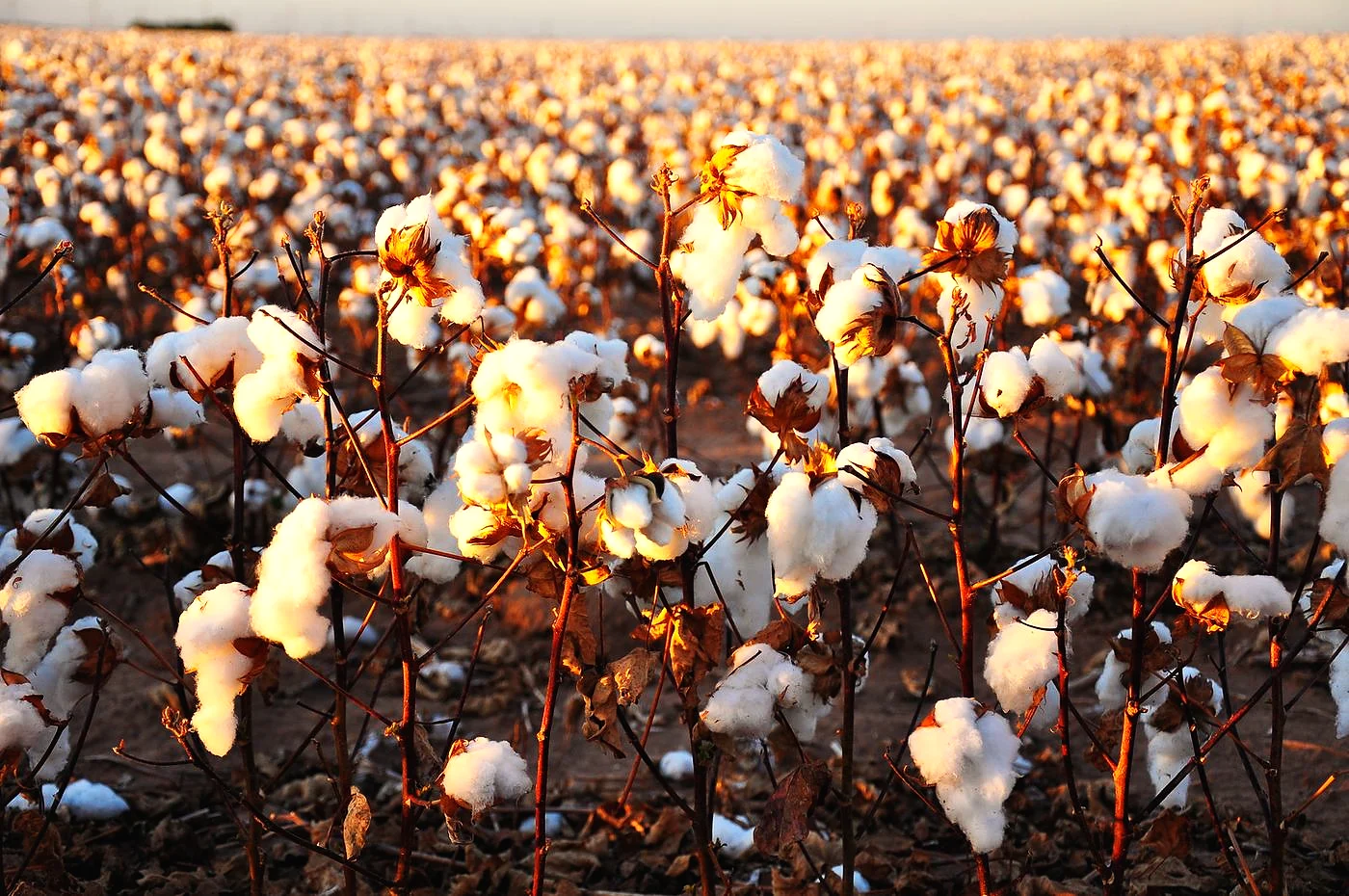
Natural and man-made
Natural fibres are grown. Man-made fibres are regenerated from dissolved wood cellulose or synthesised from oil-based polymers, and made as continuous filament or cut staple. Polyester is now over half of world fibre output; cotton is about a fifth.
| Fibre | Origin | Strengths | Limits | Typical uses |
|---|---|---|---|---|
| Cotton | Seed hair of the cotton plant | Soft, absorbent, breathable | Creases; shrinks unless finished | T-shirts, shirts, denim, towels, bedding |
| Linen | Flax stem (bast fibre) | Strong, cool, dries fast, lustrous | Creases easily; little elasticity | Summer clothing, table and bed linen |
| Wool | Sheep’s fleece | Warm, elastic, resists creasing | Can felt and shrink | Knitwear, suits, coats |
| Silk | Silkworm cocoon filament | Lustre, smooth hand, drape | Costly; weakened by light and sweat | Blouses, scarves, ties |
| Viscose | Regenerated wood cellulose | Soft, drapes, absorbent | Much weaker when wet; can shrink | Dresses, blouses, linings, blends |
| Lyocell, modal | Regenerated cellulose; lyocell solvent-spun | Soft; stronger wet than viscose | Lyocell can fibrillate (surface fuzz) | Underwear, T-shirts, bedding |
| Polyester | Synthetic (PET), virgin or recycled | Strong, quick-drying, keeps shape, cheap | Low absorbency; pills; holds oily stains | Sportswear, cotton blends, thread |
| Nylon (polyamide) | Synthetic | Very strong, resists abrasion, elastic | Low absorbency; dearer than polyester | Hosiery, swimwear, activewear |
| Elastane | Synthetic (segmented polyurethane) | Stretches several times and recovers | Never used alone; harmed by heat and chlorine | A few per cent in stretch fabrics, more in swimwear |
Cotton in depth
Upland cotton (Gossypium hirsutum) is most of world production. Extra-long staple (ELS) cotton (Gossypium barbadense: Pima, Giza) has a staple of 1 3/8 inch (about 35 mm) or more and goes into the finest yarns.
- Staple length: the mean length of the longer half of the fibres; upland usually 25–30 mm. Longer fibre spins finer, stronger, less hairy yarn.
- Length uniformity: mean length as a percentage of staple length; 80–82 is average, 83–85 high. Low uniformity means more short fibre and thick places.
- Strength: bundle breaking force in g/tex; 29–30 is strong, 31 and above very strong.
- Micronaire: airflow through a fixed mass of fibre, reading fineness and maturity together; in the US loan schedule 3.7–4.2 earns a premium, 3.4 and below or 5.0 and above a discount.
- Maturity: how far the fibre wall has thickened. Immature fibre breaks, forms neps and dyes paler: white specks in dark shades.
- Colour and trash: reflectance (Rd) and yellowness (+b) set the colour grade, such as 31 (Middling, white); trash is the surface share of leaf and bark.
Each bale’s sample is conditioned at about 21 °C and 65% relative humidity and measured on an HVI (High Volume Instrument); a classer adds the leaf grade.
Organic, Better Cotton, recycled
- Organic cotton is grown without synthetic pesticides or fertilisers, from non-GM seed, on certified organic farms; it is around 1% of world cotton. OCS or GOTS tracks it through the chain; GOTS also covers environmental and social conditions in processing.
- Better Cotton comes from licensed farms that follow its principles on crop protection, water, soil and decent work. Most is sold under mass balance: purchases are matched by licensed output, but the product need not contain that cotton. Physical models (segregation, controlled blending) keep it separate and traceable to its country of origin.
- Recycled cotton is cutting waste or used textiles shredded back into fibre. Being shorter, it is usually blended with virgin cotton or polyester and spun open-end; RCS or GRS certification verifies the content.
Blends and why they exist
A blend combines fibres for properties none has alone, or to reach a price. It is written by weight, main fibre first: 60/40 cotton-polyester.
- Cotton-polyester (CVC when cotton is over half): stronger, faster-drying, shrinks and creases less, costs less; less absorbent, pills more, and needs two dye classes.
- Cotton-elastane, often 95/5 in jersey: stretch and shape recovery for fitted garments.
- Cotton-linen: linen’s cool, dry hand and slubby look with cotton’s softness.
- Cotton-viscose and cotton-polyester-viscose: a softer hand, more drape, and a heathered look in T-shirts.
Terms in this chapter
See it in our production
Sources
- Delhom et al., “The Classification of Cotton”, Journal of Cotton Science 24 (2020) 189–196 (Cotton Ginners Handbook) (opens in a new tab)cotton.org
- NC State Extension, 2024 Cotton Information, Chapter 15: Cotton Classification (opens in a new tab)content.ces.ncsu.edu
- Textile Exchange — Materials Market Report 2025 (opens in a new tab)textileexchange.org
- Better Cotton — Physical Chain of Custody Models (opens in a new tab)bettercotton.org
- Global Organic Textile Standard (GOTS) (opens in a new tab)global-standard.org
- The Woolmark Company — What is the wool fibre? (opens in a new tab)woolmark.com
Ask your own question
Did not find the answer here? Send us your question.