From yarn to fabric
Yarn becomes fabric by weaving or knitting; without yarn, fibres are bonded. You will learn the basic weaves and knits, how a fabric is specified, and how to choose between knitted and woven for a product.
Weaving
A loom interlaces two sets of yarn. Warp runs along the fabric from a beam and carries the loom’s tension, so it is usually stronger, more twisted and sized. Weft, or filling, is inserted across one pick at a time by rapier, air jet or projectile. The firm edges are the selvedges.
- Plain: each weft passes over one warp and under the next. Firm, flat and hard-wearing: poplin, voile, canvas, calico.
- Twill: each weft floats over two or more warps, shifting by one per row, which forms a diagonal line. Drapes better and hides soiling: denim, drill, gabardine, chino.
- Satin (sateen in cotton): long floats and few, scattered interlacings give a smooth, lustrous face that snags more easily: sateen bed linen, satin linings.
Dobby and jacquard looms lift warps in groups or singly to weave patterns. Terry adds a second, slack warp that forms loops.
Knitting
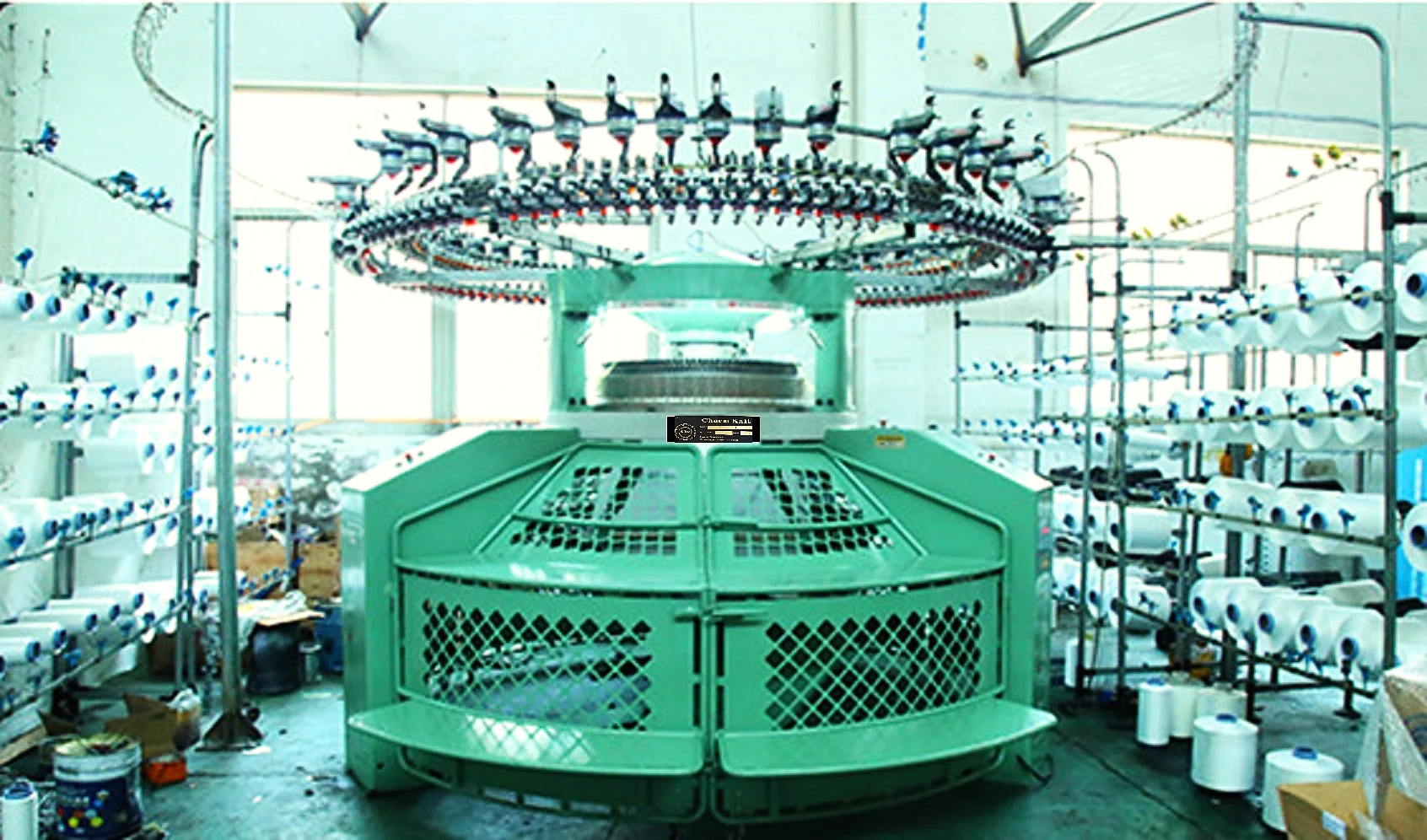
In weft knitting, yarn runs across the fabric and one yarn can form a whole row; circular machines knit a tube, flat machines knit panels. In warp knitting, each needle has its own yarn running along the fabric; tricot and raschel machines make linings, mesh, lace and sportswear that resists laddering.
A course is a row of loops across the fabric; a wale is a column of loops along it. Gauge is needles per inch (E28 means 28). Stitch length, the yarn in one loop, is the main setting for weight, tightness and shrinkage. A typical Ne 30/1 T-shirt jersey is knitted on a 24- or 28-gauge machine.
| Structure | Construction | Typical g/m² | Typical uses |
|---|---|---|---|
| Single jersey | One needle bed; V’s on the face, loops on the back; edges curl | 120–200 | T-shirts, underwear, dresses |
| Rib | Two needle beds; face and back wales alternate (1×1, 2×2) | 180–300 | Cuffs, neckbands, fitted tops |
| Interlock | Two interlocked 1×1 ribs; smooth both sides, stable, does not curl | 180–280 | Children’s wear, polos, underwear |
| Piqué | Jersey with tuck stitches forming a raised, cellular surface | 180–240 | Polo shirts |
| French terry | Jersey face; an extra yarn laid in as loops on the back | 220–320 | Sweatshirts, joggers |
| Fleece | French terry with the back loops brushed into a soft pile | 250–400 | Hoodies, tracksuits |
| Knitted terry | Pile loops on one or both faces; sheared, it becomes velour | 250–400 | Bathrobes, babywear |
Nonwovens
Nonwovens skip yarn altogether. A web of staple fibre or freshly extruded filament is bonded by needling, water jets (spunlace), heat or binders. They are fast and cheap to make but drape and recover poorly, so in apparel they serve mainly as interlinings.
Specifying a fabric
- Weight (GSM): grams per square metre, weighed on a cut 100 cm² circle. State whether it is before or after washing, and the tolerance (±5% is common).
- Width: usable width in cm or inches. Circular knits are a tube: tubular width is the flattened tube (two layers); open width is the tube slit and finished flat on a stenter, which controls width and spirality better.
- Composition: fibre content by weight, such as 95% cotton, 5% elastane. Labelling law sets the fibre names and tolerances; in the EU, Regulation 1007/2011.
- Woven construction: “40s × 40s / 133 × 72” means Ne 40 warp and weft, 133 ends and 72 picks per inch: the classic cotton poplin. Width, weave and finish follow.
- Knitted construction: structure, yarn, GSM and width, such as “single jersey, Ne 30/1 combed ring, 160 g/m², 180 cm open width”, plus stitch length and gauge if you need them fixed.
Knitted or woven?
Choose knitted fabric when the product must stretch, follow the body and feel soft: T-shirts, polos, underwear, sportswear, sweatshirts. Choose woven when it must hold a shape or crease, or resist wind and wear: shirts, trousers, jackets, workwear, bed linen. Knits shrink and twist more and need compacting and careful grading; wovens fray, need ease in the pattern unless elastane is added, and take longer to set up, since every warp is prepared on a beam.
Terms in this chapter
See it in our production
Sources
- CottonWorks (Cotton Incorporated) — Basic Woven Fabric Designs (opens in a new tab)cottonworks.com
- CottonWorks (Cotton Incorporated) — Single & Double Knits (opens in a new tab)cottonworks.com
- Groz-Beckert — Knitting: Products and services for the large diameter circular knitting sector (opens in a new tab)groz-beckert.com
- Australian Wool Education Trust / University of New England (WoolWise) — Topic 20: Formation and Properties of Knitted Structures (opens in a new tab)woolwise.com
- EDANA — How are nonwovens made? (opens in a new tab)edana.org
- Regulation (EU) No 1007/2011 on textile fibre names and related labelling and marking of the fibre composition of textile products (opens in a new tab)eur-lex.europa.eu
Ask your own question
Did not find the answer here? Send us your question.