From fabric to garment
How a garment is defined, sampled, cut, sewn, decorated and packed, and why its standard minute value sets both its price and its lead time.
The development package
A garment is ordered from a tech pack, the document that lets any factory make what the designer drew. Its core parts:
- Flat sketches with seam and stitch details.
- Bill of materials (BOM): every fabric and trim with its reference, colour and consumption per garment.
- Size chart: each point of measure (POM), such as chest width 2 cm below the armhole, with values per size and tolerances.
- Artwork for prints, embroidery and labels, with positions.
The pattern maker drafts the base size with seam allowances and the fabric’s agreed shrinkage, then grades it to every size. Exact POM definitions prevent most measurement disputes: a chest taken at the armhole and 2 cm below it are different numbers.
Samples, in order
Each sample answers one question; start the next only when the previous one is approved.
- Proto sampleThe first interpretation of the design, often in substitute fabric: style and construction.
- Fit sampleThe base size in the right or a similar fabric, checked on a fit model against the size chart.
- Size setOne garment per size, or the smallest, base and largest: checks the grading.
- Pre-production (PP) sampleBulk fabric, trims, prints and labels; once approved, the reference for the order.
- Top of production (TOP) sampleFrom the first bulk garments: confirms that production matches the PP sample.
- Shipment sampleFrom the packed goods; the buyer keeps it as a record of what was shipped.
Cutting and sewing
Software nests the pattern pieces for several sizes on a marker; marker efficiency is the area of the pieces divided by the marker’s area, the rest being waste. Relaxed knitted fabric is spread in layers without tension and cut as a stack. Consumption, for knits in kilograms per dozen, follows from marker length, usable width and GSM plus an allowance for ends and faults, so fabric delivered narrower or heavier than ordered raises the garment’s cost.
Stitch classes are defined in ISO 4915 and ASTM D6193. Knit seams must stretch, so overedge and cover stitches dominate T-shirts and polos.
| Class | Stitch | Where on a T-shirt or polo |
|---|---|---|
| 301 | Lockstitch | Polo placket, labels, collar topstitching |
| 401 | Chainstitch | Seams needing more stretch than 301; with 504 it forms safety stitch 516, mostly on wovens |
| 504 / 514 | Three- / four-thread overlock | Shoulder, side and sleeve seams, neck rib (514); edge neatening (504) |
| 406 | Two-needle coverstitch | Sleeve and bottom hems, neckband topstitching |
| 605 | Three-needle coverstitch with top cover | Flat seams, back-neck tape |
Stitches per inch (SPI) sets seam density: too few gape, too many cut or stretch knitted fabric. Knitwear commonly runs at about 10–14 SPI.
Decoration, labels and packing
Prints go on cut panels before sewing, which are easier to register and cure, or on finished garments. Screen printing uses one mesh screen per colour and suits long runs: plastisol sits on the surface, while water-based and discharge inks soak in and feel softer. DTG and DTF digital prints need no screens and suit short, multicolour runs. Embroidery is priced mainly by stitch count; a backing stops knits puckering.
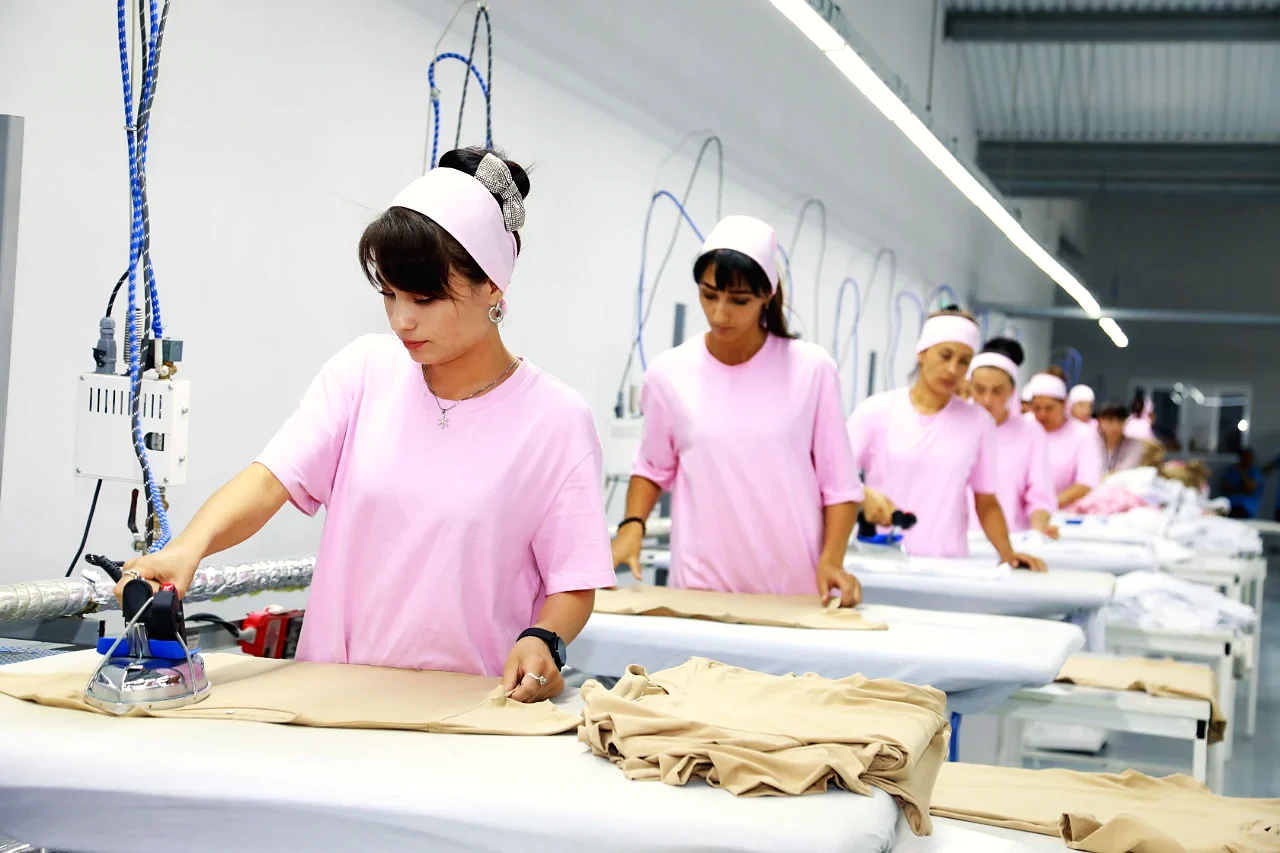
After steam pressing, each garment gets a composition label (fibre content by weight; in the EU under Regulation (EU) No 1007/2011) and a care label with the ISO 3758 symbols for washing, bleaching, drying, ironing and professional care. The Eurasian Economic Union requires labelling in Russian under TR CU 017/2011.
A solid pack holds one colour and one size per carton; an assortment, or ratio, pack holds a fixed mix, such as S:M:L:XL = 1:2:2:1, so one carton stocks a shop in every size. Carton marks, size and maximum weight follow the buyer’s packing instructions.
Standard minute value
The standard minute value (SMV) is the work-study time a trained operator needs for an operation at standard pace, with allowances. A garment’s SMV, the sum of its operations, drives price, since the cost of making ≈ SMV × cost per minute, and lead time, since daily line output = operators × minutes × efficiency ÷ SMV.
For example, 30 operators working 480 minutes at 60% efficiency make about 1,440 garments a day at SMV 6.0, but about 720 at SMV 12.0. A polo with a collar and placket has a far higher SMV than a basic T-shirt.
Terms in this chapter
See it in our production
Sources
- ASTM D6193-16(2020): Standard Practice for Stitches and Seams (opens in a new tab)store.astm.org
- CottonWorks (Cotton Incorporated): Garment construction (markers, spreading, pattern yield) (opens in a new tab)cottonworks.com
- Regulation (EU) No 1007/2011 on textile fibre names and labelling (opens in a new tab)eur-lex.europa.eu
- GINETEX: care symbols under ISO 3758:2023 (opens in a new tab)ginetex.net
Ask your own question
Did not find the answer here? Send us your question.