From fibre to yarn
Yarn decides how a fabric looks, feels and wears. You will learn how yarn is spun, how to read a count, what twist does, and what a yarn test report says.
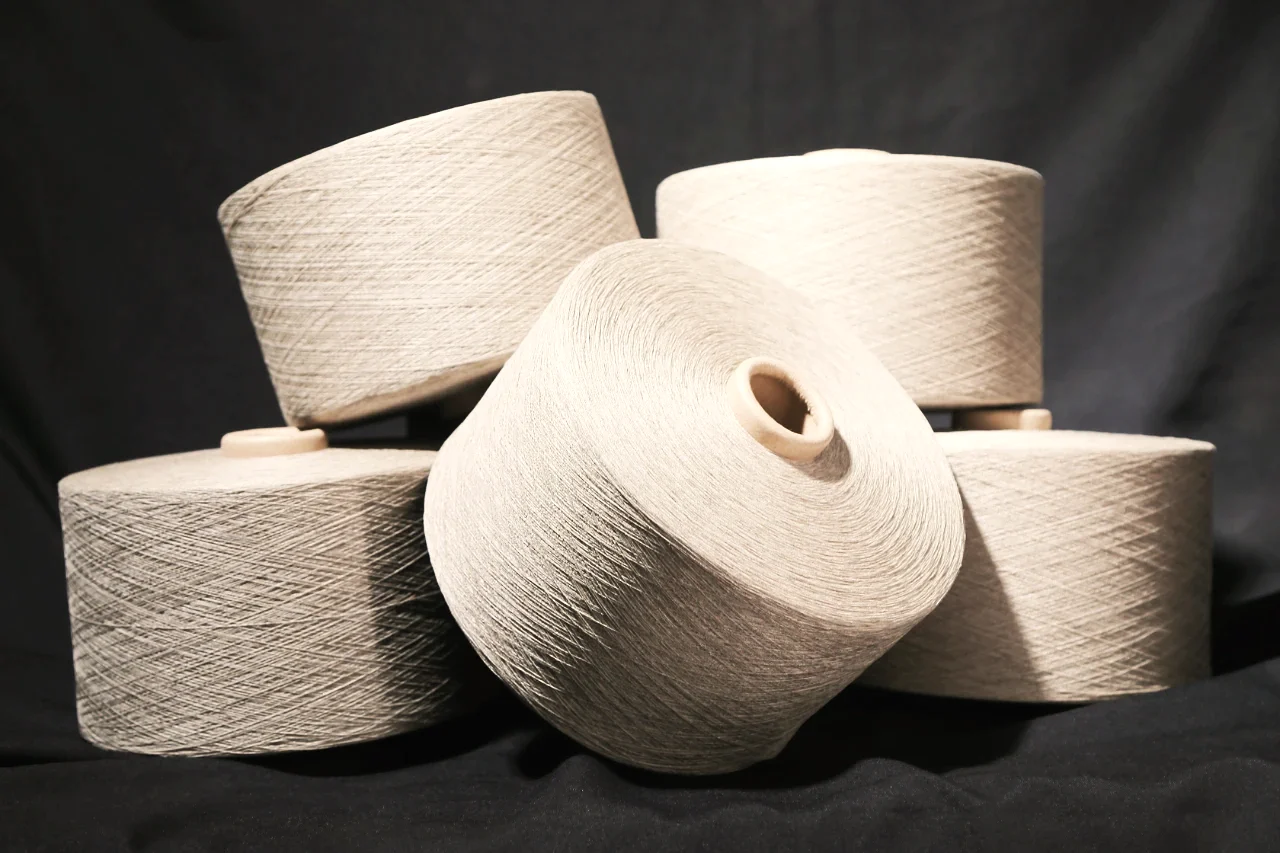
The spinning stages
- Opening and cleaningTufts from many bales are blended and cleaned of trash and dust.
- CardingWire-clothed rollers separate single fibres, remove most remaining trash and neps, and form a soft rope called sliver.
- Combing (optional)Combs remove short fibres (noil) and remaining neps.
- DrawingSix to eight slivers are combined and drawn into one, evening out thick and thin places.
- RovingRing spinning only: sliver is drawn finer and lightly twisted; rotor and air-jet machines spin straight from sliver.
- SpinningThe strand is drawn to its final fineness and twisted, or wrapped, into yarn.
- WindingYarn is wound onto cones; an electronic clearer cuts out faults and the ends are spliced.
Spinning systems
| Ring | Compact | Open-end (rotor) | Air-jet | |
|---|---|---|---|---|
| How fibres are bound | True twist from a spindle | Ring plus suction condensing before twist | Fibres reassembled and twisted in a fast rotor | Air vortex wraps outer fibres round a parallel core |
| Count range | Coarse to very fine | Medium to very fine | Coarse to medium | Medium to fine |
| Strength | High | Highest | Often 10–30% below ring | Below ring |
| Hairiness | High | Low | Low | Very low |
| Hand | Soft | Soft, smooth | Firmer, harsher | Firm, smooth |
| Typical uses | Jersey, shirting, fine fabrics | Premium knitwear and shirting | Denim, workwear, towels, basic jersey | Jersey, viscose and polyester blends, home textiles |
Carded yarn skips combing: it keeps more short fibre and neps, so it is hairier, less even and cheaper. Combed yarn is smoother, stronger and more lustrous and can be spun finer, at the cost of the fibre lost as noil. Rotor yarn is usually carded.
Count, twist and ply
Count expresses fineness: in Ne and Nm a higher number is finer; in tex, dtex and denier a higher number is coarser.
- Ne 1One 840-yard hank per pound
- Nm 11 metre per gram
- 1 tex1 gram per 1,000 m (1 dtex: per 10,000 m)
- 1 den1 gram per 9,000 m; used for filament
To convert: tex = 590.5 ÷ Ne; Nm = 1.693 × Ne; denier = 9 × tex. “Ne 30/1” is a single yarn of count 30; “Ne 40/2”, written “2/40” in some trades, is two Ne 40 singles twisted together, about as thick as Ne 20. Some suppliers quote the resultant count instead, so confirm which is meant.
Twist binds the fibres, in the Z or S direction after the slope of the spirals; singles are usually Z, and plies are twisted S over them to balance. Twist is counted per inch (TPI) or per metre; the twist multiplier αe = TPI ÷ √Ne compares counts, so an Ne 30 yarn at αe 3.5 has about 19 TPI.
More twist makes yarn stronger and harder up to an optimum, then weaker; less twist makes it softer and bulkier but hairier, so knitting yarns get less twist than weaving yarns. Twist-lively singles make single jersey spiral. Plying gives a rounder, stronger, more even yarn.
Special yarns
- Slub: thick places spun in on purpose for an irregular look.
- Melange: differently coloured fibres blended before spinning, as in grey melange.
- Mouliné: singles of different colours plied together for a speckled effect.
- Core-spun: a filament core (elastane for stretch, polyester for strength) covered with staple fibre such as cotton.
- Siro: two rovings drafted side by side and twisted together on the ring frame: a ply-like, less hairy yarn in one step.
Reading a yarn test report
- CVm%: variation of mass between 1 cm lengths of yarn; lower is more even. Uneven yarn makes cloudy fabric.
- Imperfections: thin places (−50%), thick places (+50%) and neps (+200% for ring yarn) per 1,000 m.
- Hairiness (H): total length of protruding fibres per centimetre of yarn; higher means more pilling and fly.
- Tenacity: breaking force divided by count, in cN/tex. Cotton yarns typically reach 15–26 cN/tex, with 4–10% elongation.
Mills compare these values with USTER STATISTICS, which rank a result as a percentile of mills worldwide.
Terms in this chapter
See it in our production
Sources
- Cotton Incorporated Technical Brief TRI 1014 — Yarn Numbering Systems (opens in a new tab)cottonworks.com
- Cotton Incorporated Technical Bulletin TRI-1004 — Introduction to Open-End Spinning (opens in a new tab)cottoninc.com
- The Rieter Manual of Spinning, Volume 6 — Alternative Spinning Systems (H. Stalder, Rieter, 2016; PDF hosted by U.P. Textile Technology Institute) (opens in a new tab)uptti.ac.in
- Rieter G 38 ring spinning machine brochure (technological and technical data) (opens in a new tab)rieter.com
- USTER Application Report SE 586 — Physical properties of spun yarns (opens in a new tab)uster.com
Ask your own question
Did not find the answer here? Send us your question.