Open-end, ring and air-jet yarn: how they differ
Three spinning systems turn the same fibre into yarns with a different character. What each one does best.
Key takeaways
- Ring: softest and strongest, but the lowest delivery speed.
- Open-end: fast and even, ideal for medium and coarse counts.
- Air-jet: highest delivery speed, low hairiness, resists pilling.
Every spinning system does the same basic job: it draws fibres into a thin strand and then binds it together — usually by twisting, and in air-jet spinning by wrapping. How the strand is bound changes the structure of the yarn — and with it the feel, strength and cost of the fabric.
Ring spinning
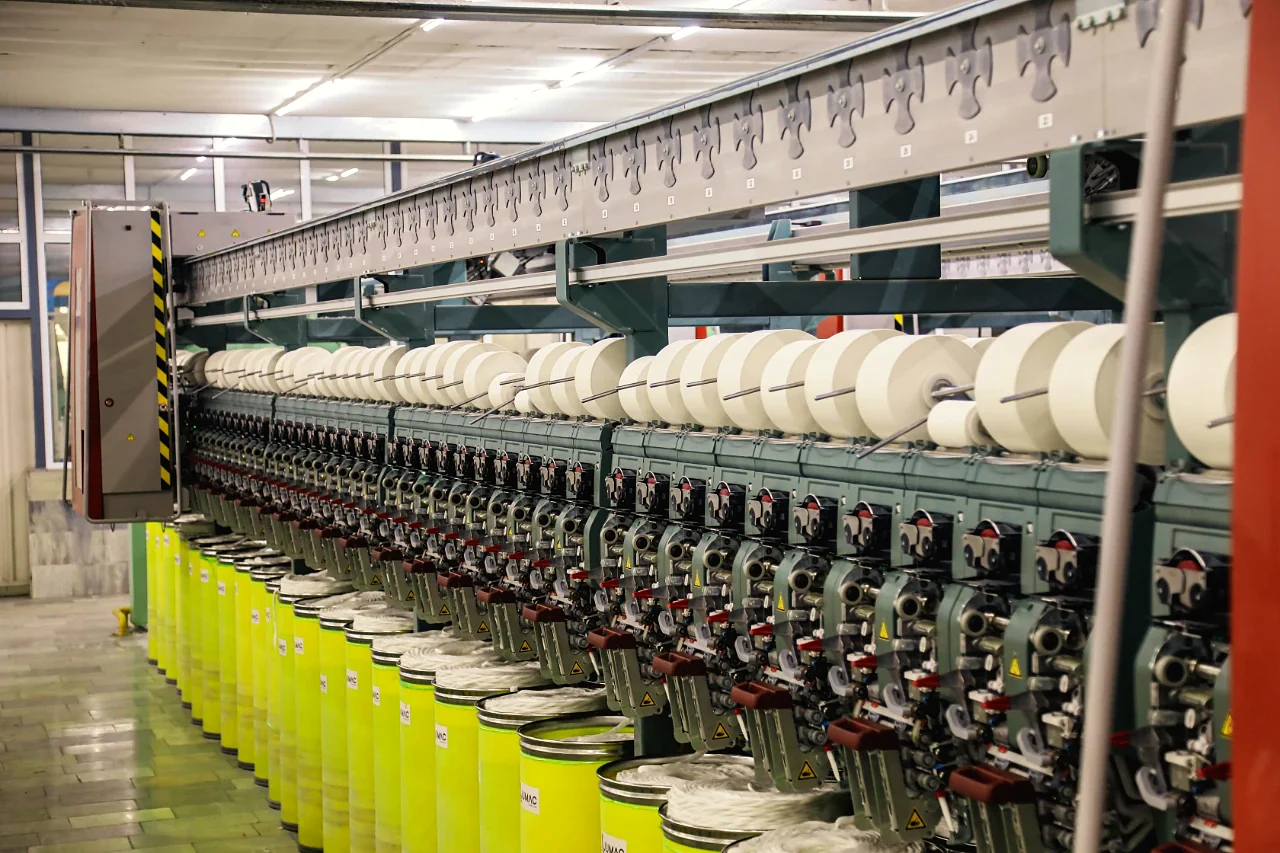
The oldest of today’s systems. Sliver is first drawn into a finer strand called roving, then drawn again and twisted by the rotating spindle, while a small traveller, dragged around the ring by the yarn, does the winding. Ring yarn is the strongest and softest and can be spun very fine, but the process is slower and has more steps. Combed ring yarn, with the short fibres removed, goes into premium garments.
Open-end (rotor) spinning
Here sliver goes straight to the spinning unit, skipping the roving stage. An opening roller separates it into individual fibres, which collect inside a rotor turning at very high speed and are twisted into yarn. Open-end is much faster than ring spinning and the yarn is very even, though harsher to the touch and typically about 10–30% weaker than comparable ring yarn, with the gap widest on long-staple cotton. It is the workhorse for medium and coarse counts: above all denim and workwear.
Air-jet spinning
A jet of compressed air wraps the outer fibres around a core of parallel fibres. Air-jet machines have the highest delivery speed of the three: up to 600 m/min, against 350 for rotor and 40 for ring. The yarn has very low hairiness, so fabrics look clean and resist pilling. It works especially well with viscose and blends.
| Ring | Open-end | Air-jet | |
|---|---|---|---|
| Delivery speed | Low | High | Highest |
| Softness | Highest | Medium | Medium |
| Hairiness | Higher | Low | Low |
| Count range | Coarse to very fine | Coarse to medium | Medium to fine |
No system is “best”. The right choice depends on the fabric, the count and the price the product has to hit.
Sources
- The Rieter Manual of Spinning, Volume 6 – Alternative Spinning Systems (Dr. Herbert Stalder, Rieter Machine Works, 2016; PDF hosted by U.P. Textile Technology Institute) (opens in a new tab)uptti.ac.in
- Cotton Incorporated Technical Bulletin TRI-1004, Introduction to Open-End Spinning (opens in a new tab)cottoninc.com
- Rieter R 70 rotor spinning machine brochure (technological and machine data) (opens in a new tab)rieter.com
- Rieter G 38 ring spinning machine brochure (technological and technical data) (opens in a new tab)rieter.com
- Rieter J 70 air-jet spinning machine – product page (opens in a new tab)rieter.com
- Rieter – R 37: New Opportunities for Recycled Rotor Yarns (opens in a new tab)rieter.com
More news and articles
All news and articles- The new bhr.uz is liveThe new bhr.uz is open in Uzbek, Russian and English, with the BHR Spinning colour card, our production stages and a knowledge base.
 Cotton vs cashmere: what’s the difference?One grows on a plant, the other on a goat. How the two fibres differ, and why one is not a cheaper version of the other.BHR · Fibre laboratory
 What does Ne 30/1 mean? Yarn count explainedThe number on a yarn spec tells you how fine the yarn is. How to read it and convert it to other systems.BHR · Spinning technologist
Still have a question on this?
Did not find the answer here? Send us your question.