Cotton vs cashmere: what’s the difference?
One grows on a plant, the other on a goat. How the two fibres differ, and why one is not a cheaper version of the other.
Key takeaways
- Cotton is a plant fibre (cellulose); cashmere is the fine undercoat of a goat (protein).
- At the same weight cashmere is warmer; cotton is cooler, tougher and easier to care for.
- A goat gives on average 100–200 g of raw down a year.
Cotton and cashmere both end up in soft, comfortable clothing, so they are easy to confuse on a label. But they come from different worlds: cotton is a plant fibre, cashmere is an animal hair. That difference shapes everything — how they feel, how warm they are, how they are cared for and what they cost.
Where they come from
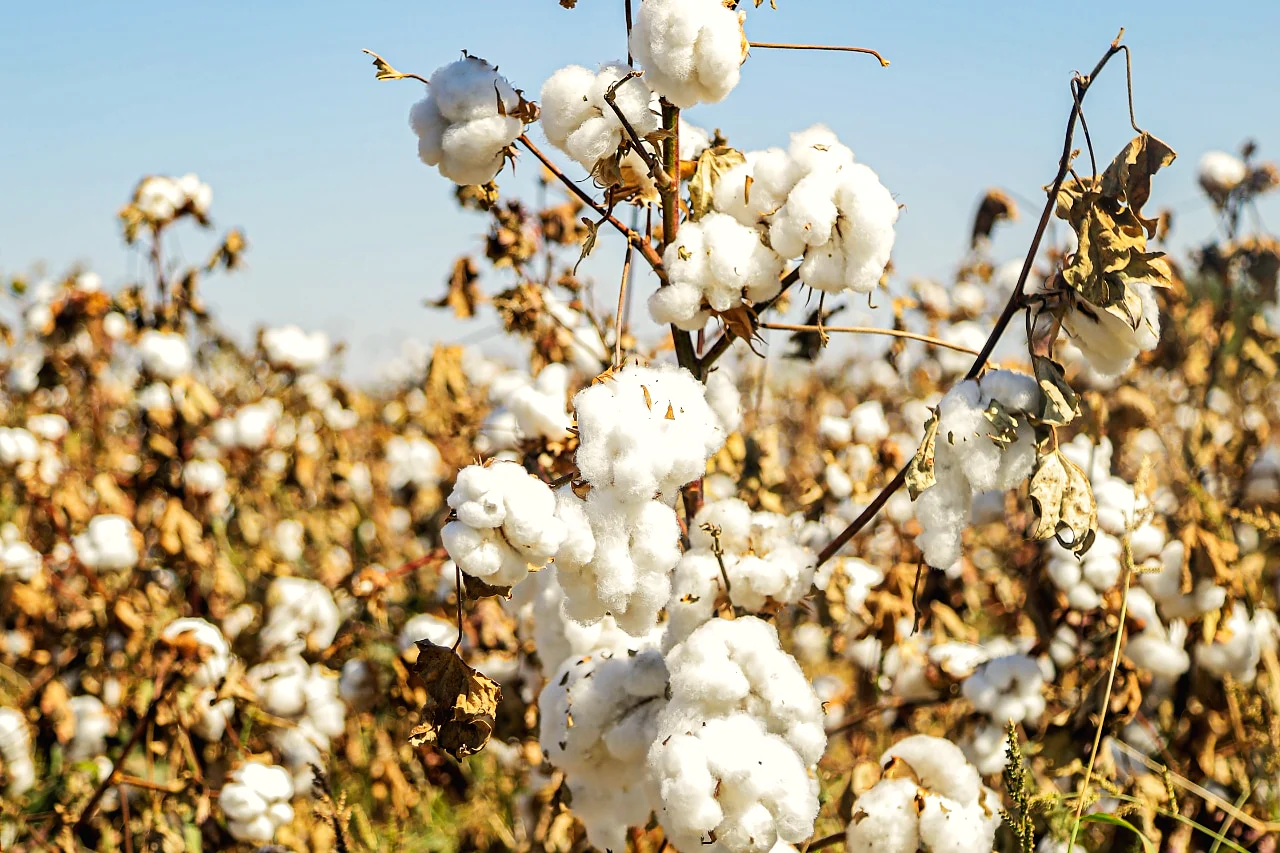
Cotton grows around the seeds of the cotton plant. After harvest, a gin separates the fibre from the seeds, and the fibre is pressed into bales for spinning.
Cashmere is the fine, soft undercoat of cashmere goats, which live in cold, dry highlands. Each spring the goats moult, and the down is either combed out by hand or shorn off. A goat gives on average about 100–200 grams of raw down a year, and at the very best around 450 grams; separating out the coarse guard hair leaves less again. That is the main reason cashmere is expensive.
What they are made of
Cotton is almost pure cellulose, the same material plants use to build their cells. Cashmere, like wool, is made of keratin, a protein. Under a microscope a cotton fibre looks like a flat, twisted ribbon, while cashmere is a round fibre covered in overlapping scales. Those scales are flatter and further apart than wool’s; that is how a laboratory tells cashmere from wool.
How they behave
| Property | Cotton | Cashmere |
|---|---|---|
| Warmth | Moderate — cool and breathable | Very high — crimped fibres trap air |
| Moisture | Absorbs well; feels damp when wet | Takes up vapour without quickly feeling damp |
| Strength | Strong, and even stronger when wet | Delicate and prone to pilling |
| Care | Machine wash — per the label, usually 30–60 °C | Hand wash in cool water, dry flat |
| Typical products | T-shirts, underwear, towels, bed linen | Sweaters, scarves, coats |
Not better or worse — different jobs
Cotton is not a cheaper cashmere, and cashmere is not a luxury cotton. Cotton is the right choice for things that touch the skin every day, get washed often and need to breathe: T-shirts, underwear, babywear, towels. Cashmere is chosen for warmth and softness in cold-weather clothing that is worn over other layers and washed rarely.
What about blends?
Labels such as “cotton-cashmere” mean a blend, usually with a small share of cashmere for softness. The composition line on the label gives the exact percentages.
Sources
- Cashmere and Camel Hair Manufacturers Institute - Fibre facts (opens in a new tab)cashmere.org
- CCMI garment care guidance for cashmere (opens in a new tab)cashmere.org
- The Woolmark Company - What is the wool fibre? (opens in a new tab)woolmark.com
- US FTC - Threading Your Way Through the Labeling Requirements Under the Textile and Wool Acts (opens in a new tab)ftc.gov
- Cotton Ginners Handbook, 2016 revised edition (Journal of Cotton Science / The Cotton Foundation; supersedes USDA Agriculture Handbook 503) (opens in a new tab)cotton.org
- Cotton Physiology (The Cotton Foundation), Chapter 23: Lint Development, E. De Langhe, KU Leuven (opens in a new tab)cotton.org
- Das, Ishtiaque, Singh & Meena, 'Tensile characteristics of yarns in wet condition', Indian Journal of Fibre & Textile Research 34 (2009) 338-344 (opens in a new tab)nopr.niscpr.res.in
More news and articles
All news and articles The new bhr.uz is liveThe new bhr.uz is open in Uzbek, Russian and English, with the BHR Spinning colour card, our production stages and a knowledge base.
 What does Ne 30/1 mean? Yarn count explainedThe number on a yarn spec tells you how fine the yarn is. How to read it and convert it to other systems.BHR · Spinning technologist
- Open-end, ring and air-jet yarn: how they differThree spinning systems turn the same fibre into yarns with a different character. What each one does best.BHR · Spinning technologist
Still have a question on this?
Did not find the answer here? Send us your question.