What does Ne 30/1 mean? Yarn count explained
The number on a yarn spec tells you how fine the yarn is. How to read it and convert it to other systems.
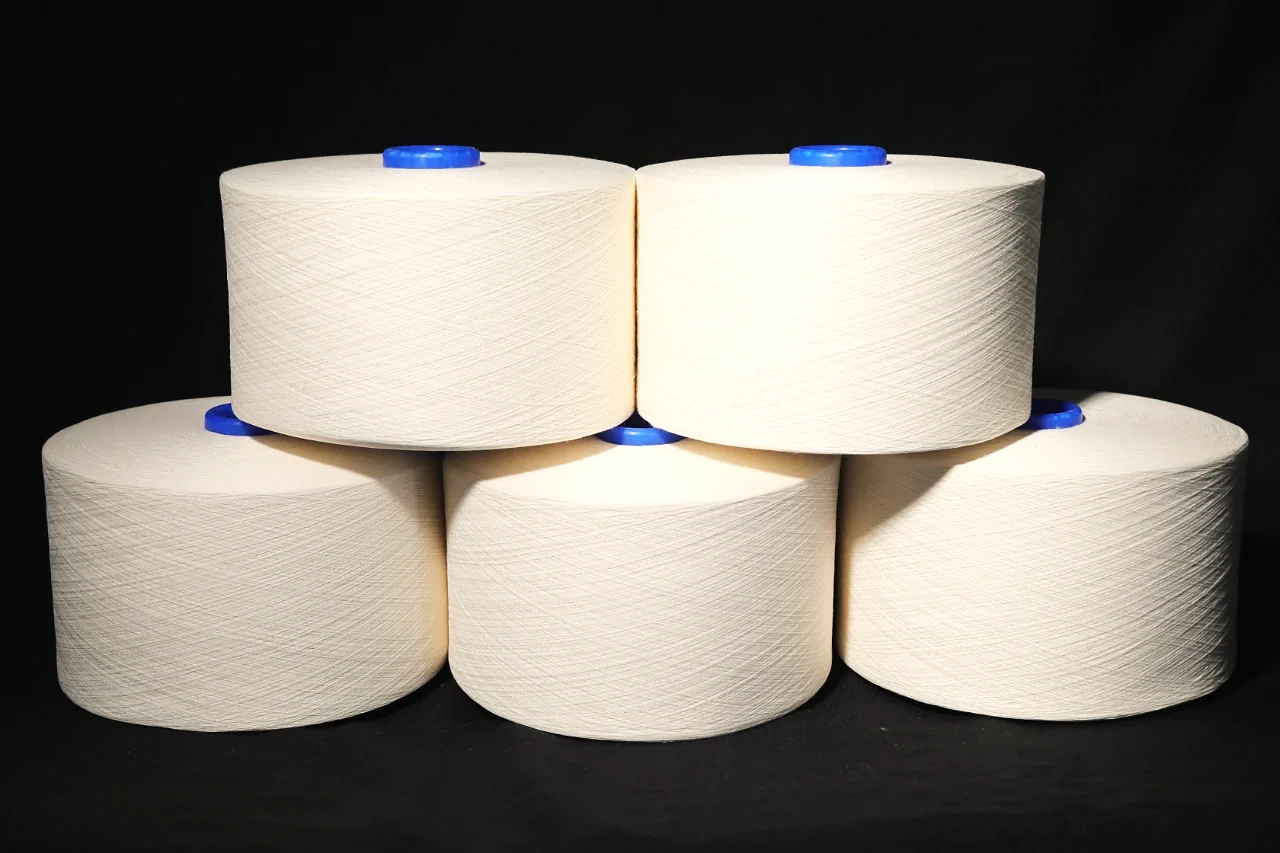
Key takeaways
- Higher Ne means finer yarn.
- /1 is a single yarn, /2 is two-ply.
- tex = 590.5 ÷ Ne.
Every yarn order starts with a number such as Ne 30/1. It describes how fine the yarn is, and it affects the weight, feel and price of the fabric made from it.
Ne: the English cotton count
Ne stands for “Number English”, the traditional system for cotton yarn. It tells you how many hanks of 840 yards make up one pound of yarn. The finer the yarn, the more length fits into a pound — so a higher Ne means a finer yarn.
- Ne 10 — thick, coarse yarn
- Ne 30 — medium, the usual count for T-shirt jersey
- Ne 50 — fine, smooth yarn
What the “/1” means
The number after the slash is the number of plies. Ne 30/1 is a single yarn. Ne 30/2 is two Ne 30 yarns twisted together: stronger, and roughly as thick as Ne 15. The notation is not universal, though: some suppliers quote the resultant count of the finished ply instead, so confirm which is meant when you order.
Other systems
Outside the cotton trade, yarn is often given in tex: the weight in grams of 1,000 metres. Tex works the other way round — a higher tex means a thicker yarn. To convert, divide 590.5 by the Ne number. The uses in the table below are ordinary mill practice, not a strict rule.
| Ne | tex | Typical use |
|---|---|---|
| Ne 10 | 59 | Denim, heavy fabrics |
| Ne 20 | 29.5 | Heavy jersey, sweatshirts |
| Ne 30 | 19.7 | Classic single-jersey T-shirts |
| Ne 40 | 14.8 | Fine jersey, lightweight garments |
The metric count Nm (metres per gram) is also widely used, mainly outside the English-speaking cotton trade: Nm = 1.693 × Ne. The wool trade has an English count of its own, Nw, based on 560-yard hanks: for the same yarn it is 50% higher than Ne.
Choosing a count
At the same stitch length, a coarser count gives heavier fabric and a finer count lighter, smoother fabric. Strength and drape depend on the spinning system, the twist and the fabric construction as much as on the count. What really sets the count is the machine and the target fabric weight: each knitting-machine gauge works best within a certain range of counts.
Sources
- Cotton Incorporated Technical Brief TRI 1014 — Yarn Numbering Systems (opens in a new tab)cottonworks.com
- CottonWorks (Cotton Incorporated) — Yarn Ply, Counts and Treatments (opens in a new tab)cottonworks.com
- CottonWorks (Cotton Incorporated) encyclopedia — English Cotton Count (opens in a new tab)cottonworks.com
- ISO 1144:2016 — Textiles: Universal system for designating linear density (Tex System) (opens in a new tab)committee.iso.org
- Cotton Incorporated Technical Bulletin ISP 1010 — Denim Fabric Manufacturing (opens in a new tab)cottoninc.com
- Cotton Incorporated Technical Bulletin TRI 3011 — Wet Processing of 100% Cotton Knitted Fabrics (opens in a new tab)cottoninc.com
- NPTEL Knitting Technology, Module 5 — FAQ (worked problems on gauge, count and fabric weight) (opens in a new tab)archive.nptel.ac.in
More news and articles
All news and articles The new bhr.uz is liveThe new bhr.uz is open in Uzbek, Russian and English, with the BHR Spinning colour card, our production stages and a knowledge base.
 Cotton vs cashmere: what’s the difference?One grows on a plant, the other on a goat. How the two fibres differ, and why one is not a cheaper version of the other.BHR · Fibre laboratory
- Open-end, ring and air-jet yarn: how they differThree spinning systems turn the same fibre into yarns with a different character. What each one does best.BHR · Spinning technologist
Still have a question on this?
Did not find the answer here? Send us your question.